
Historic preservation has become one of the most timely local-history subjects in San Mateo in 2026. After years of discussion about how the city should identify, protect, and adapt historic resources, San Mateo adopted a major update to its preservation rules this year. The changes arrive at a moment when downtown buildings, housing growth, redevelopment, and community identity are all part of the local conversation.
For anyone interested in San Mateo’s historic places, the update offers more than a change in planning policy. It provides an opportunity to reconsider how the city understands its past and how surviving buildings, streets, neighborhoods, and cultural resources can remain meaningful as San Mateo continues to evolve.
Why Historic Preservation Is a Current San Mateo Story
San Mateo has had local historic preservation regulations for decades. The city’s first Downtown Historic Preservation ordinance was established in 1993, and its preservation provisions were expanded citywide in 1995. In 2026, however, the city completed a significant modernization of that framework.
The revised Historic Preservation Ordinance was adopted on May 18, 2026, and became effective on June 17. According to the ordinance, the changes were intended to reflect current preservation-planning practices, provide clearer procedures, align local policy with state law, and implement goals contained in San Mateo’s General Plan 2040.
The city has also described a growing community interest in how preservation should interact with other priorities, including property-owner participation and new housing. Its Historic Policy Update Effort brought together ordinance revisions, public workshops, planning hearings, and the development of a broader citywide historical framework.
A New Framework for Understanding Historic San Mateo
One of the most important parts of the recent effort is the Citywide Historic Context Statement. Rather than focusing only on isolated old buildings, a context statement looks at the larger patterns that explain why places may matter.
The state’s documentation for the San Mateo Citywide Historic Context Statement describes it as a framework for understanding the city’s history through significant themes, events, and patterns of development. It is also intended to help guide consistent evaluations of whether properties may qualify for local historic recognition.
This broader approach matters because local history is rarely contained within a single landmark. Transportation corridors, commercial districts, neighborhoods, schools, civic buildings, businesses, and residential architecture can all illustrate different stages of a city’s development.
For readers exploring downtown San Mateo history, that means familiar streets can be viewed as interconnected pieces of a larger historical landscape rather than simply as collections of individual buildings.
What Makes a Place Historically Significant?
Age alone does not automatically make a building historically important. San Mateo’s updated rules establish criteria for evaluating historic significance and integrity.
Under the 2026 ordinance, a potential historic resource may qualify because it is connected to important historical events, associated with people or communities significant to the past, represents distinctive architectural or construction characteristics, or may provide important information about history or prehistory.
The ordinance generally requires an individual resource to be at least 50 years old before it can be considered for local landmark designation. Proposed historic districts also have age and contributing-resource requirements.
These concepts are similar to broader preservation practices used across California. The California Register of Historical Resources, administered through the California Office of Historic Preservation, recognizes resources connected to important historical patterns, people, architecture, archaeology, and cultural significance.
Historic Downtown Remains Especially Important
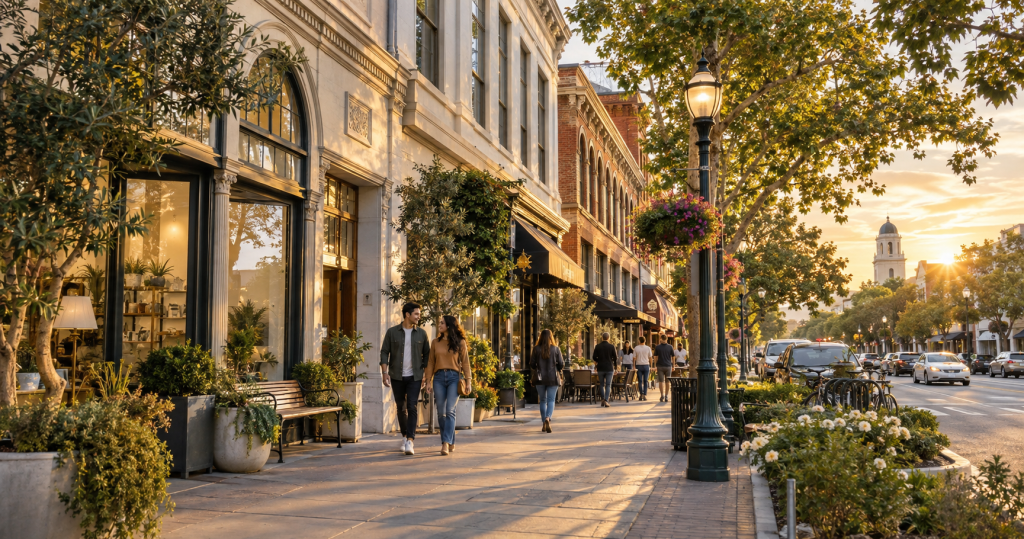
Downtown San Mateo provides a particularly visible example of why preservation continues to matter. Commercial buildings from different periods stand near newer construction, restaurants, offices, transportation facilities, and redevelopment projects.
The mix illustrates an important preservation challenge: cities are not static. Historic districts must continue functioning as places where people work, shop, live, and gather.
San Mateo maintains information about its local surveys, design guidelines, district documentation, and preservation policies through its official Historic Resources program. Those materials help explain how the city evaluates older properties and how preservation considerations can become part of planning decisions.
That makes downtown especially useful for understanding San Mateo architecture. Changes to windows, storefronts, rooflines, exterior materials, additions, and other character-defining elements can affect how clearly an older building continues to communicate its history.
Preservation Does Not Always Mean Freezing a Building in Time
A common misconception is that historic preservation requires every building to remain exactly as it looked decades ago. In practice, preservation planning often focuses on retaining significant character while allowing buildings to continue serving useful purposes.
The National Park Service Standards for Rehabilitation describe rehabilitation as making compatible use of a property possible through repairs, alterations, and additions while preserving the features that convey its historical, architectural, or cultural values.
That distinction is important in an active downtown. Older buildings may require accessibility improvements, mechanical upgrades, seismic work, new uses, or carefully designed additions. The goal of sensitive rehabilitation is not necessarily to recreate a vanished moment in time. Instead, it is to accommodate change without unnecessarily erasing the features that give the building historic meaning.
A Downtown Project Shows How the Process Can Work
Recent work at 44 East Third Avenue offers a local example. The city reports that exterior modifications at the building associated with Draper University were reviewed with historic considerations in mind. Revised plans included roof and mechanical-screening changes, and the city’s historical consultant found the revised proposal consistent with applicable preservation standards and downtown design guidelines.
The project’s official city project page notes that a building permit was issued in February 2026 and work began later in the year.
Examples like this show why preservation is often less about choosing between “old” and “new” than about deciding how the two can coexist.
The New Historic Resources Commission
San Mateo’s 2026 changes also created a Historic Resources Commission to serve as a review body under the updated preservation program. The commission includes appointed members as well as youth advisory members, adding another formal venue for considering the city’s historic resources.
The commission’s creation reflects a broader shift toward making preservation decisions through a defined public process. That matters because the identification of San Mateo landmarks can involve property owners, planners, historians, architects, residents, and elected officials with different perspectives on what deserves recognition and how preservation should operate.
Why Historic Context Matters Beyond Individual Buildings
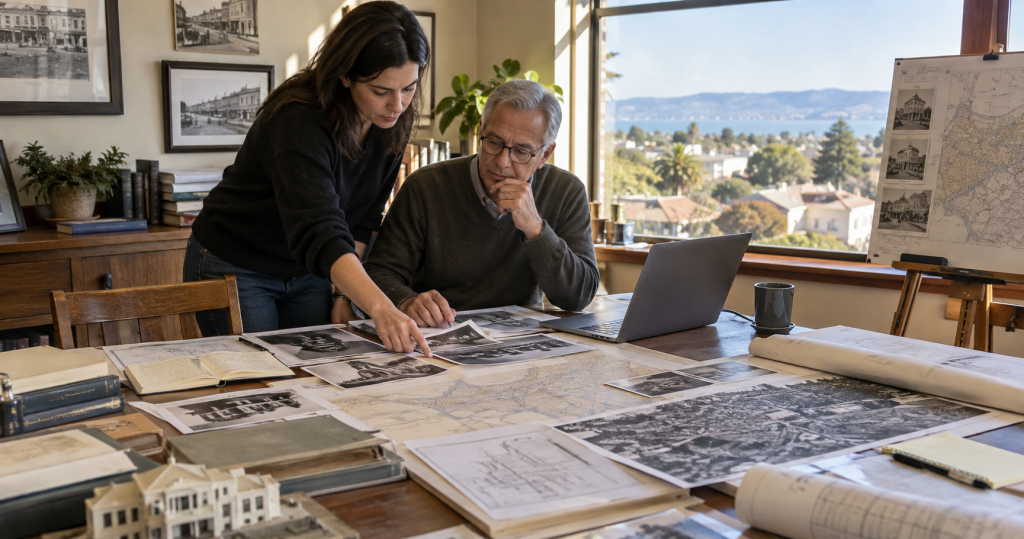
One of the most valuable aspects of a citywide historical framework is its ability to bring attention to stories that may not be represented by monumental architecture.
A modest commercial building can matter because of the business that operated there. A neighborhood may illustrate a period of population growth or changing housing patterns. A transportation corridor can reveal how residents once moved between work, shopping districts, schools, and neighboring communities.
Preservation therefore connects naturally with subjects such as transportation history, community life, neighborhood development, local businesses, and historic photographs. When these stories are considered together, San Mateo’s built environment becomes a record of social and economic change rather than simply a collection of old structures.
Preservation and Change Will Continue Together
San Mateo continues to experience development pressure and demand for housing, commercial space, transportation improvements, and updated public infrastructure. Historic preservation does not remove those pressures. Instead, it creates another layer of information for understanding what may be affected when places change.
The city’s 2026 policy update explicitly places preservation within a broader planning conversation. That makes the subject especially relevant now. Decisions involving historic resources are increasingly tied to questions about housing, adaptive reuse, neighborhood character, economic activity, and long-term city growth.
Why 2026 May Become an Important Year in San Mateo History
It is too early to know exactly how the updated rules and citywide historical framework will shape San Mateo over the coming decades. What is already clear is that 2026 represents a notable point in the evolution of the city’s preservation program.
The new ordinance establishes clearer criteria and procedures. The citywide context statement offers a broader way to interpret local history. The Historic Resources Commission adds a dedicated review structure. Together, these changes provide new tools for deciding how San Mateo recognizes and manages places connected to its past.
For local-history readers, the most interesting question may be what comes next. As buildings are evaluated, neighborhoods studied, and development projects reviewed, additional stories about San Mateo’s architecture, communities, businesses, and changing landscape are likely to emerge.
That is what makes historic preservation more than a planning issue. It is also a way of asking what parts of a city’s story remain visible, what has already disappeared, and what future generations may still be able to experience.